If you’ve ever walked out of a wedding, product launch, or conference thinking “someone made all of this happen, and I want that job,” you’re not alone. Event planning jobs are some of the most in-demand roles in the hospitality and business-services world right now, and event management careers offer something rare: a mix of creativity, logistics, people skills, and real career mobility, without necessarily requiring a specialized four-year degree to get your foot in the door.
This guide walks through everything you need to know to start a career in event management in 2026 — what the job actually looks like day to day, which entry points make sense for beginners, which certifications are worth your money, what you can realistically expect to earn, and a step-by-step plan for landing your first role or first client. Whether you’re a student weighing majors, a career changer coming from retail or hospitality, or someone already coordinating events informally for friends and community groups, this is a practical roadmap, not just theory.
What Does an Event Planner Actually Do?
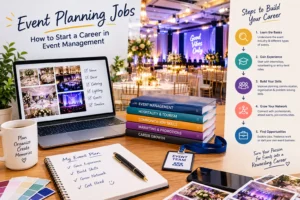
The job title “event planner” covers a wide range of day-to-day work, but the core of the role is the same everywhere: you are the person responsible for turning a concept into a live, working experience, on time and on budget.
A typical event planner’s job description includes:
- Discovery and briefing: Meeting with a client, employer, or stakeholder to understand the purpose of the event, the audience, the budget, and the non-negotiables.
- Budgeting: Building and managing a detailed budget across venue, catering, décor, entertainment, staffing, transportation, and contingency costs.
- Vendor sourcing and negotiation: Researching, vetting, and contracting venues, caterers, AV companies, florists, photographers, and rental companies, then negotiating pricing and terms.
- Logistics and timelines: Creating run-of-show documents, floor plans, and minute-by-minute timelines that every vendor and staff member follows on event day.
- Marketing and registration (for public or ticketed events): Coordinating with marketing teams or handling registration platforms, invitations, and attendee communication directly.
- On-site management: Overseeing setup, managing the event in real time, solving problems as they arise, and running teardown.
- Post-event reporting: Reconciling budgets, gathering feedback, and reporting on outcomes like attendance, engagement, or ROI for corporate events.
The exact mix depends heavily on specialization. A corporate meeting planner spends more time on logistics, AV, and stakeholder management. A wedding planner spends more time on design and client relationships. A nonprofit event planner often wears a fundraising hat too. Understanding which flavor of the job appeals to you is the first real decision in planning your career path.
Why Consider a Career in Event Management?
Event management careers appeal to people who like variety, tangible results, and work that doesn’t look the same every day. A few reasons the field continues to attract new talent:
- Steady, above-average job growth: Government labor projections for meeting, convention, and event planners continue to show growth that outpaces the average for all occupations, driven by the return and expansion of in-person corporate events, conferences, weddings, and experiential marketing.
- A real career ladder: You can move from coordinator to planner to senior planner to director of events, or pivot sideways into venue sales, destination management, sponsorship, hospitality technology, or event marketing — the skill set transfers across all of them.
- Multiple entry points: Unlike fields that demand a specific degree, event planning welcomes people from hospitality, communications, business, marketing, and even completely unrelated backgrounds who can demonstrate organizational skill and composure under pressure.
- Freelance and business ownership potential: Once you have a track record, independent event and wedding planners can build a business with per-event pricing well above what an entry-level salary pays, with income tied directly to how many clients you can serve.
- Tangible, visible impact: Few jobs let you point to a finished result — a flawless gala, a sold-out conference, a wedding that ran without a hitch — and say, “I built that.”
That said, it’s worth being honest about the trade-offs too: irregular hours, weekend and evening work, high-pressure problem-solving on event day, and a learning curve around vendor negotiation and budgeting. If those trade-offs sound like a fair exchange for the upside, event management is worth pursuing seriously.
Types of Event Planning Jobs You Can Start With
One of the best things about this field is how many doors lead into it. Here are the most common entry level event planning jobs and where you’re likely to find them.
1. Event Coordinator (Corporate or Agency)
Often the first formal title in the field. You’ll support a senior planner with logistics, vendor communication, and administrative work — think building spreadsheets, confirming headcounts, and managing RSVP lists — while learning how full events are run from the inside.
2. Wedding Planning Assistant
Working under an established wedding planner is one of the fastest ways to learn client management and design sensibility. Many assistants eventually launch their own wedding planning businesses.
3. Venue Coordinator
Working directly for a hotel, event space, restaurant, or unique venue. You manage the logistics for events booked at that specific location, which teaches you the operational side of events (catering, room turns, AV, capacity limits) extremely well.
4. Nonprofit Events and Fundraising Assistant
Nonprofits regularly run galas, auctions, and community events on lean budgets, which makes this an excellent training ground for resourcefulness and vendor negotiation.
5. Meeting and Conference Coordinator
Found inside associations, universities, and corporations that run recurring conferences, trainings, or internal meetings. This track leans heavily into logistics, contracts, and AV/tech coordination.
6. Trade Show and Exhibit Coordinator
Works with companies or agencies that manage booths and presence at industry trade shows — a mix of logistics, shipping, design, and brand representation.
7. Catering or Hospitality Coordinator
Many planners start in catering sales or hospitality operations, which builds food and beverage knowledge that transfers directly into event planning.
8. Freelance/Volunteer Event Support
If you can’t land a paid role immediately, volunteering to run logistics for a community event, a nonprofit’s fundraiser, or a friend’s wedding is a legitimate way to build a portfolio when you have zero professional experience.
Look for these roles under job titles like “Event Coordinator,” “Event Assistant,” “Meeting Planner,” “Catering Coordinator,” “Guest Experience Coordinator,” and “Marketing Events Assistant” — many event planning jobs are posted under adjacent titles rather than “Event Planner” outright, especially at the entry level.
Skills You Need to Break Into Event Planning
Hiring managers in this field consistently look for a specific combination of hard and soft skills. Building these event planning skills — even before you have a job title — is what makes your resume and portfolio credible.
- Organization and project management: You are juggling dozens of moving pieces with hard deadlines that cannot slip. Comfort with checklists, timelines, and project management tools (Asana, Trello, Monday.com) is non-negotiable.
- Budgeting and basic financial literacy: You don’t need an accounting degree, but you do need to be comfortable building and tracking a budget in a spreadsheet, understanding deposits and payment schedules, and spotting cost overruns early.
- Vendor negotiation: Learning to get fair pricing and favorable contract terms without damaging the relationship is a skill that improves with repetition — start practicing it even in small ways (negotiating your own vendor contracts for a personal event is good practice).
- Communication and client management: You will translate a client’s vague vision into a concrete plan, manage expectations, and deliver difficult news (budget cuts, vendor cancellations) calmly and clearly.
- Composure under pressure: Things go wrong on event day — a caterer is late, the AV fails, the weather turns. The planners who thrive are the ones who can solve problems quietly without panicking the room.
- Creativity and design sense: Especially for social and wedding events, a good eye for décor, color, flow, and guest experience sets you apart.
- Basic tech fluency: Comfort with registration platforms (Eventbrite, Cvent), design tools (Canva), floor-planning software, and increasingly, AI-assisted planning and scheduling tools, is now expected rather than optional.
- Contract literacy: Reading vendor contracts closely enough to catch cancellation clauses, liability terms, and hidden fees will save you (and your clients) real money.
How to Become an Event Planner: Step-by-Step
There’s no single required path into event planning jobs, but the following sequence reflects how most successful planners actually broke in.
Step 1: Pick a Niche to Start With
You don’t need to commit forever, but starting with a focus — corporate events, weddings, nonprofit, or trade shows — makes your first 1–2 years far more efficient because you’re building a specific, recognizable skill set and network rather than a little bit of everything.
Step 2: Get Educated (Degree Optional, Knowledge Not)
A bachelor’s degree in hospitality management, business, communications, or marketing is common among employed planners and can help with corporate roles, but it is not strictly required. If a four-year degree isn’t the right fit, a certificate program in event or meeting planning from a community college, extension school, or online platform can teach the fundamentals in a fraction of the time and cost.
Step 3: Get Hands-On Experience, Even Unpaid
Volunteer to help run a local nonprofit’s fundraiser. Offer to coordinate logistics for a friend’s wedding at cost. Intern with a local venue or planning company. The goal is to have at least one real, verifiable event you can talk about in an interview and show in a portfolio.
Step 4: Build a Portfolio
Document everything: photos of the event space, the run-of-show you built, the budget you managed, a short write-up of the problem you solved on the day. A simple portfolio website or PDF with 3–5 events (even small ones) is more persuasive to employers than a resume alone.
Step 5: Apply for Entry-Level and Adjacent Roles
Cast a wide net across “Event Coordinator,” “Event Assistant,” catering, hospitality, and venue roles, not just jobs titled “Event Planner.” Many planners’ first paid role is in a related function that exposed them to events regularly.
Step 6: Network Deliberately
Join a local chapter of an industry association, attend vendor open houses, and connect with planners on LinkedIn. Event planning is a relationship-driven industry — a large share of jobs and freelance work come through referrals rather than job boards.
Step 7: Pursue Certification Once You Have Some Experience
Certifications carry more weight once you have real events under your belt to apply them to. Most require a minimum number of hours of experience to sit for the exam (more on this below).
Step 8: Decide Between In-House and Independent
After a year or two of experience, you’ll have a clearer sense of whether you want the stability of an in-house or agency role, or the flexibility (and risk) of running your own event planning business.
Event Planner Certifications Worth Earning
Certification isn’t required to work in the field, but the right credential signals seriousness to employers and clients, and can help you command higher rates. The most recognized event planner certifications include:
- Certified Meeting Professional (CMP): Offered by the Events Industry Council, this is widely considered the gold standard for corporate and association meeting planners. It requires a combination of work experience and continuing education hours before you’re eligible to sit the exam, which makes it a mid-career credential rather than a starting point.
- Certified Special Events Professional (CSEP): Offered through the International Live Events Association, this credential focuses more broadly on live and special events, including social and corporate events, and similarly requires documented experience.
- Wedding-specific certifications: Several organizations offer wedding and social-event planning certificates aimed at newcomers with little or no prior experience — useful for building foundational knowledge and a credential to put on a new business website, even before you’re eligible for CMP or CSEP.
- Digital Event Strategist (DES) and hybrid/virtual event credentials: As hybrid and virtual events have become permanent fixtures rather than pandemic-era workarounds, credentials focused on virtual platforms and digital engagement have become a useful differentiator, especially for corporate and association planners.
A practical approach: start with a foundational certificate program if you’re new to the industry, build 1–2 years of real experience, then work toward CMP or CSEP once you’re eligible, since both carry real weight with employers and corporate clients.
Event Planner Salaries: What to Expect
Compensation in event planning varies enormously by specialization, geography, employer type, and whether you’re employed or self-employed, so treat these as directional ranges rather than guarantees.
- Entry-level roles (event coordinator, assistant) typically start somewhere in the high $30,000s to mid $40,000s annually, depending on market and employer.
- Mid-career event planners with a few years of experience commonly land in the $50,000–$80,000 range, with corporate and financial-services employers tending to pay toward the higher end of that band.
- Senior and specialized planners — corporate event managers, directors of events, and experienced independent planners with strong client rosters — regularly clear $85,000–$105,000+, with top performers in high-cost markets going higher still.
- Independent and freelance planners don’t earn a salary at all; income is a function of how many events you book and what you charge per event. Independent wedding and event planners commonly charge anywhere from roughly $1,500 for month-of coordination up to $10,000+ for full-service planning on larger budgets, with luxury full planning sometimes priced as a percentage of total event spend rather than a flat fee. This means an established independent planner’s annual income depends heavily on volume, niche, and market, and can significantly exceed typical in-house salaries once a strong client base is built — but it also comes with none of the income stability of a salaried role, especially in the first year or two.
Industry and location matter more than almost anything else. Planners in financial services, technology, and large corporate environments tend to out-earn planners in nonprofit or small-business settings, and major metro markets generally pay more than smaller ones, though cost of living should be weighed against that gap.
Going Independent: Starting Your Own Event Planning Business
Many planners eventually ask how to start an event planning business rather than staying employed. A few realities worth knowing before you make that leap:
- You need a track record first: Clients trust planners with visible proof of past events — a portfolio, testimonials, and ideally a specific niche you’re known for (say, destination weddings, corporate retreats, or milestone birthdays).
- Business basics matter as much as planning skill: You’ll need to register your business, get liability insurance, set up contracts and deposit structures, and build at least a simple pricing model before taking your first paying client.
- Vendor relationships are your business infrastructure: A strong independent planner has a trusted bench of caterers, venues, photographers, and rental companies they can call on — this is built over years, not overnight, which is another reason in-house experience first tends to pay off.
- Marketing is now part of your job description: Independent planners need a website, a presence on Instagram or Pinterest (especially for weddings and social events), and a referral pipeline through past clients and vendor partners.
- Cash flow is uneven: Bookings, deposits, and event dates rarely land evenly across the year — many independent planners have distinct busy and slow seasons and need to budget accordingly.
Going independent isn’t the only “real” version of this career — plenty of experienced planners build excellent, well-paid careers entirely in-house or at agencies. It’s a choice about risk tolerance and how you want to work, not a required final step.
Common Challenges in Event Planning (and How to Prepare for Them)
Being honest about the harder parts of the job will help you decide if it’s the right fit and prepare you to handle them well:
- Irregular hours: Events happen on weekends and evenings, which means your schedule won’t look like a typical 9-to-5, especially early in your career.
- High-pressure problem solving: Something will go wrong on event day, almost without exception. The skill isn’t preventing every problem — it’s solving it calmly and quietly enough that guests never notice.
- Physical demands: Setup and teardown, being on your feet for long stretches, and long event days are part of the job, particularly for coordinators and wedding planners.
- Client management: Especially in weddings and social events, managing expectations, budgets, and sometimes difficult family dynamics is as much a part of the job as logistics.
- Seasonality: Wedding and outdoor-event planners in particular often deal with a busy season and a much quieter off-season, which affects both workload and, for independents, cash flow.
None of these are reasons to avoid the field — they’re simply part of an honest job description, and planners who go in with clear eyes tend to build longer, more sustainable careers.
Tools and Technology Event Planners Use
Modern event planning jobs increasingly expect comfort with a standard tech stack:
- Project management: Asana, Trello, Monday.com, or similar tools to track tasks and timelines.
- Registration and ticketing: Eventbrite, Cvent, and similar platforms for managing RSVPs, ticketing, and attendee communication.
- Design and floor planning: Canva for marketing materials and simple design; dedicated floor-planning software for layout and seating.
- Budgeting: Spreadsheets remain the backbone of most event budgets, alongside dedicated event-budgeting software at larger organizations.
- Communication and collaboration: Slack, shared calendars, and cloud file storage for coordinating with vendors, clients, and internal teams.
- AI-assisted planning tools: A growing number of planners now use AI tools for first-draft timelines, vendor research, email drafting, and budget modeling, which speeds up the administrative side of the job without replacing the judgment and relationship management planners bring.
You don’t need to master every tool before applying for jobs, but familiarity with the categories above — and a willingness to learn new platforms quickly — is a real advantage in interviews.
Industries That Hire Event Planners
Event planning jobs exist far beyond wedding and hospitality companies. Understanding the full range of employers helps you widen your search and find the specialization that fits your interests.
- Corporate and financial services: Large companies employ in-house event teams to run internal conferences, client appreciation events, product launches, and executive off-sites. These roles tend to pay well and offer clear advancement paths into event marketing or experiential marketing leadership.
- Technology companies: Tech firms run a heavy calendar of product launches, developer conferences, and hybrid/virtual events, and often look for planners comfortable with fast timelines and digital platforms.
- Hospitality and venues: Hotels, convention centers, restaurants, and unique event spaces employ venue-side coordinators who manage everything booked at that location, which is one of the most accessible entry points into the field.
- Nonprofits and associations: Galas, fundraisers, member conferences, and advocacy events are a major source of entry-level and mid-career roles, often with more responsibility earlier than a large corporate team would offer.
- Government and education: Universities, school districts, and government agencies host conferences, commencement ceremonies, public events, and trainings, and typically hire in-house event or meeting staff.
- Entertainment and sports: Concert promoters, sports franchises, and entertainment venues need planners for fan events, hospitality suites, tours, and large-scale live productions.
- Wedding and social event companies: Independent planning firms and boutique agencies focused specifically on weddings, milestone birthdays, and private social events remain one of the most visible entry points into the field, especially for creatively minded planners.
- Destination management companies (DMCs): These firms specialize in planning events, logistics, and experiences for out-of-town or international clients in a specific destination — a great fit for planners who enjoy travel and local vendor networks.
A Day in the Life: What Event Planning Actually Feels Like
Job descriptions rarely capture the texture of the work, so here’s a realistic look at two very different but equally common days.
- A planning-phase day (weeks before an event) might include: a morning client call to review the latest budget draft, two hours comparing catering proposals and negotiating a per-head price, an afternoon spent building a run-of-show document in a shared spreadsheet, a quick site visit to confirm a venue’s loading dock access, and an evening email to a vendor confirming final headcount changes. Most of this work happens at a desk or on-site during business hours, and the pace, while busy, is manageable.
- Event day looks completely different: an early arrival to oversee setup, a walkthrough with the venue and catering team to confirm everything matches the floor plan, hours spent managing the run-of-show in real time — cueing speakers, troubleshooting a late vendor delivery, adjusting the timeline on the fly when a program segment runs long — and a late finish overseeing teardown and vendor load-out. This is the high-adrenaline side of the job, and it’s the part that either confirms this career is right for you or tells you it isn’t.
Most planners describe the rhythm as long stretches of detailed, almost administrative planning work punctuated by short, intense bursts of live execution — which is exactly why organizational skill and composure under pressure are the two traits hiring managers screen for most heavily.
Building a Resume and Interview Story With Little or No Experience
If you’re breaking in without a formal events background, the way you frame your existing experience matters as much as the experience itself.
- Reframe adjacent experience: Retail management, restaurant service, customer service, administrative assistant roles, and volunteer coordination all involve the same underlying skills event planning requires: juggling multiple priorities, working under time pressure, handling logistics, and managing people. Translate that experience into event-planning language on your resume — “coordinated staffing schedules for a 20-person team” reads as directly relevant, even if it wasn’t technically an “event.”
- Lead with outcomes, not tasks: Instead of listing what you did, quantify the impact: “Managed a $3,000 budget for a 150-guest fundraiser, coming in 8% under budget” is far more compelling than “helped plan a fundraiser.”
- Prepare a specific problem-solving story: Interviewers in this field almost always ask some version of “tell me about a time something went wrong and how you handled it.” Have a real, specific example ready — even from a small or volunteer event — that shows calm, resourceful problem-solving under pressure.
- Bring your portfolio to the interview, not just your resume: A short deck or PDF with photos, a sample run-of-show, and a budget summary from even one or two events does more to prove capability than any bullet point can.
- Ask informed questions: Asking about typical event sizes, team structure, and how the company handles vendor relationships signals that you understand the job, not just the job title.
Networking and Professional Associations Worth Joining
Because so much event planning work moves through referrals, building a professional network early pays off disproportionately compared to other fields.
- Meeting Professionals International (MPI) hosts local chapters with regular networking events, education sessions, and job boards focused on corporate and association meeting planning.
- International Live Events Association (ILEA) connects planners across corporate, social, and special-event specialties and administers the CSEP credential.
- Events Industry Council is the umbrella organization behind the CMP certification and a useful source of industry research and standards.
- National Association for Catering and Events (NACE) is especially valuable for planners working closely with catering and hospitality partners.
- Local wedding and vendor associations exist in most major markets and are often the fastest way for aspiring wedding planners to meet photographers, florists, and venues who can become referral partners.
Attending even a handful of local chapter events per year, introducing yourself to vendors and planners, and following up consistently will do more for your job search and client pipeline than applying to job postings alone.
Frequently Asked Questions
Do I need a degree to work in event planning?
No specific degree is legally required, and many successful planners come from hospitality, business, communications, or unrelated backgrounds. A degree can help for corporate roles at larger organizations, but hands-on experience and a strong portfolio often matter more to hiring managers.
How long does it take to become an event planner?
You can land an entry-level coordinator role within a few months if you build a small portfolio through volunteer or assistant work. Reaching a senior or independent planner level with strong earning potential typically takes two to five years of steady experience.
Is event planning a stressful job?
It can be, particularly around event day and peak season. Planners who build strong systems, checklists, and vendor relationships tend to manage the stress far better than those improvising each event from scratch.
What’s the difference between an event planner and an event coordinator?
Coordinators typically execute logistics under a planner’s direction — confirming vendors, managing timelines, handling on-site details. Planners usually own client relationships, budgets, and overall event strategy from concept through execution. Coordinator is the more common entry-level title.
Can I become a wedding planner with no experience?
Yes, but it requires deliberate portfolio-building — assisting an established planner, offering discounted or pro-bono planning for a friend’s wedding, or completing a wedding planning certificate program to demonstrate foundational knowledge before you start marketing yourself to paying clients.
Is a certification like CMP worth it?
For corporate and association event planning specifically, yes — CMP is widely recognized and can help with both hiring and rate negotiation. For social and wedding planners, a foundational certificate plus a strong portfolio often matters more early on, with CSEP or similar credentials adding value once you have significant experience.
How much can I really earn as an independent event planner?
It depends entirely on how many events you book and your pricing model. Coordination-only services for a single event might bring in a modest flat fee, while full-service planning on larger budgets can bring in several thousand dollars per event. Annual income for independents is a function of volume × average fee, minus business costs like insurance, software, and marketing — which is why most planners spend their first year or two building a client pipeline before expecting the business to replace a full-time salary.
What’s the best way to specialize once I have some experience?
Pay attention to which events energize you rather than drain you, and which type of client relationship you enjoy most — a single couple for a wedding, a repeat corporate client for quarterly events, or a nonprofit board for an annual gala are very different working relationships. Most planners narrow their focus naturally within their first two to three years, once they’ve sampled a few event types and noticed where their strongest results and best referrals are coming from.
Do event planners travel much? I
t varies widely. Corporate and destination-event planners can travel frequently, sometimes internationally, for site visits and on-site execution. Local wedding and social-event planners, and most venue-side coordinators, typically stay within a single metro area. If travel is a priority (or something you want to avoid), it’s worth asking about explicitly in interviews, since it isn’t always obvious from the job title alone.
Final Thoughts
A career in event management rewards people who like solving real problems, working with people, and seeing a project through from a blank page to a finished, lived experience. The path in isn’t a single ladder — it’s closer to a set of doors, from corporate coordination to weddings to nonprofit fundraising to trade shows, all of which can lead to the same senior-level opportunities and, eventually, the option to build an independent business if that’s the direction you want to take.
Start small, document everything you do, invest in the right certification once you have real experience to back it up, and treat every event — no matter how small — as proof you can deliver. That combination is what turns “I want to work in events” into an actual, sustainable career.