Few things change how you feel about a night out faster than the right outfit. Whether it’s a wedding reception, a rooftop cocktail evening, a festive family function, or a birthday bash with your closest friends, party wear dresses for women are having a genuine moment in 2026. After a few years of quiet, minimalist dressing, fashion has swung firmly back toward glamour — sequins, bold color, sculptural silhouettes, and fabrics that catch the light.
But with so many options — from bodycon mini dresses to flowing lehenga gowns to sharply tailored jumpsuits — choosing the right party dress for women can feel more overwhelming than exciting. This guide breaks it all down: the biggest 2026 trends, how to choose a dress for your body type and the occasion, the fabrics and colors worth knowing, and practical styling tips you can actually use — whether you’re shopping online or planning your look ahead of time.
1. What Counts as Party Wear in 2026?
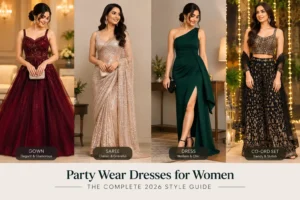
The old rulebook — formal gowns for formal events, casual clothes for everything else — has essentially dissolved. Today, party wear dresses for womens are defined less by a rigid dress code and more by intent: pieces that show you’ve made an effort and that reflect a confident, expressive version of yourself.
That said, a few characteristics define party wear this year:
- Elevated fabrics. Silk, velvet, organza, brocade, and structured crepe dominate over everyday cottons and jerseys.
- Statement details. Embellishment, embroidery, cutouts, and dramatic silhouettes have replaced subdued, minimalist cuts.
- Color confidence. Jewel tones, vivid brights, and rich, saturated neutrals are everywhere — beige-on-beige minimalism has taken a back seat.
- Cultural fusion. Indo-Western silhouettes are now mainstream party wear for wedding function choices — think lehenga-style gowns, dhoti pants paired with structured blazers, and saree-drape dresses that blend tradition with a modern cut.
In short, “party wear” today is a mindset as much as a category — and that’s good news, because it means there’s a version of it that suits every taste, budget, and body type.
2. Top Party Wear Trends for Women This Year
If you only take five trends away from this guide, make it these. They’re the ones showing up across runways, red carpets, and — more importantly — in what real people are actually buying and wearing.
The Bold, Sculptural Party Dress
After years of pared-back minimalism, 2026 is unapologetically loud. High-volume sleeves, structured bustiers, dramatic ruffles, and sculptural cuts are everywhere. This is the year to pick the dress you’d normally talk yourself out of — the one with the exaggerated shoulder or the thigh-high slit. Designer party wear dresses from major labels are leaning hard into this “more is more” energy, and fast-fashion retailers have followed close behind, making the look accessible at every price point.
Sequins and All-Over Shine
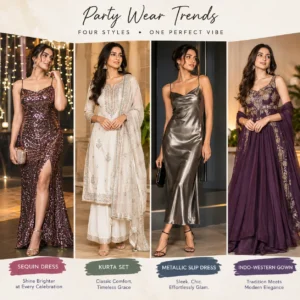
Sequins never really go out of style at party season, but 2026 has pushed them further — full sequin mini dresses, halter-neck sparkle styles, and sequin-embellished maxi gowns are dominating “what to wear” searches. A sequin party dress remains one of the easiest ways to look instantly festive without needing to overthink accessories — the dress does the work.
The Embellished Kurta Set
In Indian and South Asian party fashion, the embellished kurta set has become the dominant silhouette. A heavily embroidered or sequinned kurta paired with straight-cut or palazzo pants delivers the comfort of Indian silhouettes with the visual punch of formal wear. The most sought-after party wear kurta sets in 2026 typically feature:
- Chikankari embroidery on georgette or organza, in soft pastel tones like mint, lavender, and blush
- Sequin and zari work on velvet or silk, ideal for evening functions
- Mirror-work detailing in bright, festive colors
- A printed or embellished dupatta used as the true statement piece, elevating a simpler kurta-pant base
Indo-Western Fusion Dresses
The line between Indian and Western party wear keeps blurring. Indo-western party dresses — lehenga-cut gowns, saree-drape dresses, and dhoti pants worn with tailored blazers — have moved from niche to mainstream. They’re especially popular for wedding-adjacent events like sangeets and receptions, where guests want something festive but not a full traditional outfit.
The Metallic Moment
Metallic fabrics — liquid gold, gunmetal silver, bronze, and copper tones — are having a strong year, especially in bodycon and slip-dress silhouettes. A single metallic dress can function as your go-to for an entire party season because it photographs beautifully under any lighting.
Bows, Cutouts, and Asymmetry
Smaller trend details worth knowing: bow embellishments (on straps, waists, or as statement back details), strategic cutouts at the waist or shoulder, and asymmetrical hemlines that add movement without adding bulk.
The Return of the Little Black Dress
Some things are trend-proof. The LBD always resurfaces during party season, and 2026 is no exception — it remains the easiest party dress for women to own because it works for nearly any occasion and pairs with practically anything in your jewelry box.
Tailored Party Suits and Co-ord Sets
Not every party look has to be a dress. Structured blazers paired with matching trousers or skirts — often in satin, sequin, or velvet fabric — have become a genuine alternative to the traditional dress silhouette. This trend is popular among women who want the elegance of party wear with the comfort and coverage of tailoring, and it photographs especially well for corporate cocktail events where a dress might feel slightly too casual or slightly too formal.
Statement Sleeves
Puffed shoulders, balloon sleeves, and dramatic bishop cuffs are a quiet but consistent thread through 2026 collections. A dress with a fairly simple body but a dramatic sleeve gives you the “statement piece” effect without needing head-to-toe embellishment — a useful trick if you want to feel trend-forward without committing to a fully sequinned or heavily embroidered look.
Lehenga Gowns as the New Traditional Staple
Lehenga gowns — a skirt cut like a traditional lehenga but sewn as a single gown rather than a two-piece with a dupatta — have become one of the fastest-growing categories in festive party wear. They offer the drama and volume of a traditional lehenga without the layering and draping effort, which makes them a favorite for younger shoppers attending sangeets, receptions, and Diwali parties.
3. Indian, Western, and Indo-Western Party Wear: How They Differ
Since so much of the search interest around party wear dresses for women spans both Indian and Western fashion, it’s worth breaking down how the three categories differ and when each one makes sense.
- Western party wear typically refers to structured, single-piece dresses — bodycon, cocktail, maxi, and slip styles — often in solid colors or subtle prints, designed to be worn without additional draping. These work well for corporate events, birthdays, date nights, and Western-style weddings.
- Indian party wear includes kurta sets, lehenga-choli, anarkalis, and saree-based outfits, typically featuring embroidery, zari work, or mirror detailing. These are the default choice for religious festivals, traditional ceremonies, and most wedding functions in South Asian communities.
- Indo-Western fusion wear sits between the two — a lehenga-cut gown, a saree-drape dress, or a dhoti-pant-and-blazer combination. This category has grown the fastest over the last few years because it lets people show up “festive enough” for a cultural event without wearing a full traditional outfit, and it also appeals to younger shoppers who want something that feels more current than a classic saree or lehenga but more occasion-appropriate than a plain Western dress.
Knowing which category a specific event calls for is often more important than knowing the trends themselves — a stunning sequin bodycon dress might be the wrong choice for a temple function, just as a heavily embroidered lehenga might feel like overkill at a casual rooftop party.
4. Types of Party Dresses and When to Wear Them
Not every party calls for the same silhouette. Here’s a practical breakdown of the main types of party wear and where each one fits best.
Bodycon Dresses
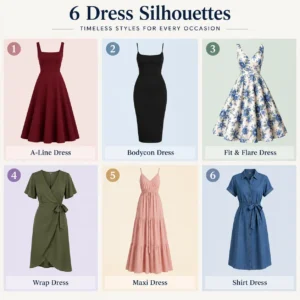
Fitted from top to bottom, bodycon dresses flatter and highlight the natural shape of the body. Best for: clubs, birthday parties, cocktail evenings, date nights. Look for stretch fabric blends (with a touch of spandex or elastane) so the fit is comfortable, not restrictive.
Cocktail Dresses
Typically knee-length or just above, cocktail dresses sit in the sweet spot between casual and formal. They’re the safest, most versatile pick for women’s cocktail dresses situations — engagement parties, work functions, semi-formal dinners.
Maxi and Evening Gowns
Floor-length silhouettes for black-tie events, weddings, and galas. Evening gowns for women in 2026 favor slit details, one-shoulder necklines, and fluid fabrics like satin and crepe that move well on the dance floor.
Slip Dresses
A minimalist, bias-cut silhouette usually in satin or silk. Understated but elegant, slip dresses have re-emerged as a favorite for smaller, more intimate parties where you want to look put-together without full-on drama.
Fit-and-Flare Dresses
Fitted at the top with a flared skirt, this shape is universally flattering and works especially well for dancing-heavy events since the skirt has movement.
Lehenga Gowns and Indo-Western Dresses
A hybrid of a traditional lehenga skirt and a modern gown silhouette — no dupatta required. Ideal for festive dresses for women situations like sangeets, Diwali parties, and receptions.
Jumpsuits
Not technically a dress, but worth mentioning — party jumpsuits (wide-leg or fitted, often in satin or sequin fabric) have become a mainstream alternative for women who want the polish of a dress with the comfort of pants.
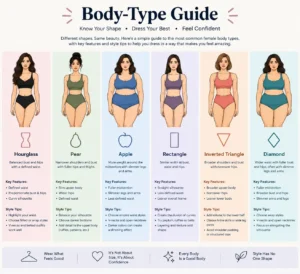
5. How to Choose Party Wear Dresses by Body Type
There’s no single “correct” body type for party wear — every shape can wear every trend. The goal is choosing cuts that make you feel confident, not chasing a silhouette because it looked good on someone else. Here are some general starting points.
Pear Shape (fuller hips, narrower shoulders)
Fit-and-flare and A-line dresses balance proportions beautifully. Structured necklines — boat neck, off-shoulder, or halter — draw attention upward. Embellished tops paired with simpler flowing skirts also work well.
Apple Shape (fuller midsection)
Empire-waist dresses that skim rather than cling through the middle are especially flattering. Wrap dresses, and dresses with strategic draping around the waist, create definition without pulling tight across the stomach.
Hourglass Shape (balanced shoulders and hips, defined waist)
Bodycon and belted dresses that follow the natural waistline highlight this shape well. Most silhouettes work — the key is avoiding boxy cuts that hide the waist entirely.
Rectangle Shape (balanced shoulders and hips, less defined waist)
Peplum dresses, wrap styles, and dresses with ruching or belting at the waist help create curves. Fabrics with texture (sequins, embroidery) also add visual dimension.
Petite Frames
Higher hemlines, vertical design lines, and monochrome dressing help elongate the frame. Avoid overly voluminous skirts, which can overwhelm a smaller frame.
Tall Frames
Maxi dresses, wrap styles, and dresses with horizontal design details all work beautifully, since a taller frame can carry more fabric and more dramatic silhouettes without looking overwhelmed.
The bigger takeaway: party wear dresses for different body types isn’t about hiding your shape — it’s about choosing cuts that highlight what already feels good to you.
6. Fabrics That Define 2026 Party Wear
Fabric choice affects everything — how a dress moves, how it photographs, and how comfortable you’ll be for hours at a time.
- Velvet — plush and rich, ideal for winter parties and evening events; photographs beautifully under warm lighting.
- Satin and silk — fluid, elegant, and slightly reflective; works well for both slip dresses and structured gowns.
- Sequin fabric — maximum sparkle for shorter, high-energy events; less ideal for sitting-heavy occasions like long dinners.
- Organza and tulle — lightweight and voluminous, common in layered skirts and statement sleeves.
- Georgette and chiffon — soft and breathable, popular for embellished kurta sets and flowy Indo-Western pieces.
- Structured crepe — holds its shape well, ideal for tailored, sculptural silhouettes.
- Brocade and jacquard — textured, richly patterned fabrics that add visual depth without needing extra embellishment.
A quick rule of thumb: pick fluid fabrics (satin, chiffon, georgette) for dinner parties where you’ll be seated for long stretches, and structured or stretch fabrics (crepe, bodycon jersey blends) for dancing-heavy events where you need to move freely.
7. Color Guide: What’s Trending and What’s Timeless
Trending in 2026
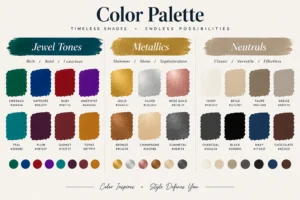
- Jewel tones — emerald, sapphire, ruby red, and amethyst purple are dominating festive dressing this year.
- Metallics — liquid gold, bronze, and gunmetal silver.
- Bold brights — fuchsia, cobalt blue, and tangerine orange for those who want to stand out.
- Rich neutrals — chocolate brown, deep camel, and espresso tones as a sophisticated alternative to classic black.
Timeless and Safe
- Black — always appropriate, always slimming, always easy to accessorize.
- Wine and burgundy — flattering on most skin tones and works across seasons.
- Classic red — a reliable statement color for celebratory occasions.
- White and ivory — increasingly popular for summer parties and daytime celebrations (just double-check it’s appropriate for the specific event, especially weddings).
Choosing Color by Skin Tone
As a general starting point (not a hard rule — personal preference matters more than any formula):
- Warm undertones (skin that leans golden or peachy) tend to be flattered by earthy jewel tones — olive, rust, mustard, and warm reds — as well as gold-based metallics.
- Cool undertones (skin that leans pink or blue) often look striking in jewel tones like sapphire, emerald, and true red, along with silver-based metallics.
- Neutral undertones have the most flexibility and can generally wear both warm and cool palettes well.
If you’re ever unsure, jewel tones as a category are close to universally flattering, which is part of why they’ve become the dominant color story for 2026 party wear across both Western and Indian fashion. Bright, saturated colors also tend to photograph better under evening and indoor lighting than muted pastels, which can look washed out in photos taken under warm artificial light.
8. Styling Party Wear Dresses: Shoes, Jewelry, and Bags
The dress is only half the outfit. Here’s how to finish the look without overdoing it.
Shoes
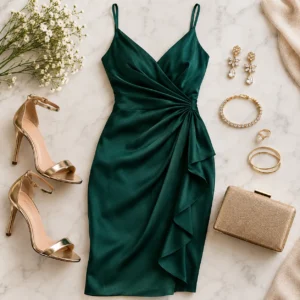
- Heavily embellished dresses pair best with simple, minimal footwear — a nude or metallic strappy heel lets the dress stay the focus.
- Simple slip dresses can handle a bolder shoe — a statement heel or embellished sandal.
- For dancing-heavy events, block heels or platform sandals offer sparkle without sacrificing comfort.
Jewelry
- If your dress is heavily embellished (sequins, embroidery, mirror-work), keep jewelry minimal — small studs, a delicate bracelet, nothing competing for attention.
- Simple dresses (slip dresses, solid-color bodycon) can carry statement jewelry — chunky earrings, a bold necklace, or layered bracelets.
- Metallic dresses generally pair better with jewelry in the same metal tone (gold dress, gold jewelry) for a cohesive look.
Bags
Small clutches remain the default for evening events — they hold the essentials without adding visual bulk. For events where you’ll be on your feet for hours, consider a small crossbody in a metallic or neutral tone that won’t clash with the outfit.
Hair and Makeup Pairing
Styling doesn’t stop at accessories. A heavily embellished dress or an elaborate neckline generally looks best with hair pulled back or styled up (a sleek bun, a low chignon, or soft waves swept to one side), so the neckline and embroidery stay visible rather than getting covered. Simpler dresses — a slip dress or a solid-color bodycon — can carry more voluminous, down-styled hair since there’s less competing detail. On makeup, the same “let one element lead” principle applies: a bold lip pairs naturally with more minimal eye makeup, and a dramatic smoky eye tends to look best with a more neutral lip, so the overall look stays balanced rather than competing with the dress for attention.
Layering for Cooler Weather
Winter and cooler-climate parties don’t have to mean sacrificing your outfit for warmth. A structured blazer in velvet or satin, a faux-fur stole, or a tailored long coat can all be layered over a party dress without hiding it — in fact, many of 2026’s sculptural blazers and coats are designed specifically to be worn open, as a frame around the dress rather than a cover-up for it. Choose a wrap or jacket in a complementary (not competing) color and fabric weight so the layers feel intentional rather than like an afterthought.
9. Party Wear for Every Occasion
Wedding Guest / Reception
Go festive but avoid white (unless explicitly told it’s welcome) and avoid outshining the couple with excessive embellishment. An Indo-Western fusion dress, embellished kurta set, or a rich jewel-toned gown all work well.
Cocktail Parties and Work Functions
Knee-length cocktail dresses in structured fabrics strike the right balance — polished without being overly formal. Stick to solid colors or subtle patterns.
Birthday Parties and Nights Out
This is where you can have the most fun — bodycon dresses, sequins, bold color, and shorter hemlines are all fair game.
New Year’s Eve
Sparkle is basically the unofficial dress code. Sequins, metallics, and anything with shine fit the celebratory mood of the night.
Festive / Cultural Celebrations (Diwali, Eid, etc.)
Embellished kurta sets, lehenga gowns, and rich jewel-toned fabrics like silk and velvet are ideal — festive without requiring a full traditional outfit.
Black-Tie and Formal Galas
Full-length evening gowns in elegant, fluid fabrics like satin or crepe, paired with minimal but polished accessories.
Party Wear Dresses for Teens
Younger shoppers looking for party wear dresses for teens generally want trend-driven pieces at a lower price point — think shorter hemlines, playful colors, and fun details like bows or metallic threads, without the heavier embellishment or price tag of formal adult occasion wear. Comfort and ease of movement matter more here, since teen parties tend to be higher-energy, dance-heavy events.
Party Wear for Older Women
Party wear doesn’t stop being fun after a certain age — it just shifts in emphasis. Many women in their 40s, 50s, and beyond gravitate toward elegant midi and maxi lengths, structured tailoring, and richer, more sophisticated color palettes (deep jewel tones, metallics, classic black) over very short hemlines or heavy sequins. A well-cut wrap dress, a tailored jumpsuit, or an elegant shirt dress in a luxe fabric can look just as festive as a bodycon mini, while feeling more true to personal style.
10. Budget-Friendly Party Wear Shopping Tips
You don’t need a designer budget to look put-together. A few practical tips:
- Invest in one versatile “hero” dress — a well-made LBD or a jewel-toned midi dress that works across multiple events, and rotate accessories to change up the look each time.
- Rent for one-time, high-visibility events — designer rental platforms have made high-end party wear far more accessible for weddings and galas you’ll only wear once for.
- Shop off-season — party wear collections go on sale right after the holiday season; buying ahead for next year saves significantly.
- Prioritize fabric quality over embellishment — a well-made dress in a good fabric will photograph and wear better over time than a heavily embellished piece in cheap material.
- Restyle what you already own — a simple dress can look entirely different with a statement belt, jacket, or different jewelry.
- Compare local tailors versus ready-made pieces In many markets, getting a simple base dress custom-stitched by a local tailor, then adding your own embellishment or accessories, works out cheaper than a comparable ready-made designer piece — and gives you a better fit.
- Watch for end-of-season and festival sales Major shopping events (post-holiday clearance, festive season sales, end-of-summer clearance) are when party wear retailers discount heaviest, since the category is highly seasonal.
- Read fabric and fit reviews before buying online Party wear is one of the categories most affected by inconsistent online sizing — a few extra minutes reading buyer reviews and checking measurements against your own can save you a costly return.
11. Common Mistakes to Avoid When Buying Party Dresses
- Buying for the trend, not the occasion: A dramatic sculptural gown might be stunning, but it’s the wrong choice for a casual house party.
- Ignoring fabric behavior: Some fabrics wrinkle badly in transit or crease after sitting for hours — check reviews before buying online.
- Skipping the size chart: Party wear brands, especially international or Indo-Western labels, often run differently from everyday clothing sizes — always check the specific brand’s chart rather than assuming your usual size.
- Over-accessorizing an already busy dress: If the dress has embellishment, embroidery, or sequins, let it lead — don’t compete with heavy jewelry on top of it.
- Not accounting for the venue: Outdoor events, weather, and how long you’ll be standing versus seated should all factor into your choice.
- Waiting until the last minute for alterations: Party wear, especially anything embellished or made-to-measure, often needs hemming or minor fitting adjustments. Buying at least a week or two ahead of the event leaves room for this.
- Forgetting to test movement, not just the mirror: A dress can look perfect standing still and feel completely different once you sit, dance, or raise your arms. Where possible, move around in a dress before committing to it for a full night out.
12. How to Care for Your Party Wear Dresses
Party dresses often use delicate fabrics and embellishments that don’t hold up to regular washing routines.
- Sequin and embellished pieces should generally be dry-cleaned or hand-washed cold, and always hung to dry — never wrung out.
- Silk and satin should be stored on padded hangers to avoid shoulder creasing, and ironed on the lowest heat setting (or steamed instead).
- Velvet should never be ironed directly — steam it from a distance to release wrinkles without crushing the pile.
- Store special-occasion pieces in garment bags, away from direct sunlight, to prevent fading and dust buildup between wears.
13. Frequently Asked Questions
What are the best party wear dresses for women in 2026?
The standout trends this year are sequin mini and maxi dresses, embellished kurta sets, metallic slip dresses, and Indo-Western fusion gowns — all leaning into bold color and statement detailing rather than minimal, understated looks.
How do I choose a party dress for my body type?
Focus on cuts that highlight your natural proportions — fit-and-flare or A-line for pear shapes, empire waists for apple shapes, bodycon or belted styles for hourglass shapes, and peplum or wrap styles for rectangle shapes. Comfort and confidence matter more than following a rigid rule.
What color party dress is safest for a wedding function?
Rich jewel tones (emerald, sapphire, wine) are the safest festive choice for most wedding functions. Avoid white or ivory unless you know it’s explicitly acceptable at that particular event.
Are sequin dresses appropriate for daytime parties?
Sequins work best for evening events under artificial or dim lighting, where they catch light dramatically. For daytime parties, a structured cocktail dress in a bold color or subtle metallic tends to look more polished.
How can I buy party wear dresses on a budget?
Invest in one versatile piece you can restyle with different accessories, shop end-of-season sales, consider rental platforms for one-time formal events, and prioritize fabric quality over heavy embellishment.
What’s the difference between a cocktail dress and an evening gown?
Cocktail dresses are typically knee-length and suited to semi-formal events, while evening gowns are floor-length and reserved for more formal, black-tie-style occasions.
Can I wear the same party dress to multiple events?
Yes, and it’s one of the smartest ways to shop. A solid-color midi or maxi dress in a versatile jewel tone or black can be restyled with different jewelry, shoes, and outerwear across several occasions — a statement clutch and heels for one event, a tailored blazer and flats for a more toned-down version of the same look at another.
How far in advance should I buy party wear for a wedding season?
For anything requiring alterations, embellishment, or a made-to-order piece, aim to buy at least three to four weeks ahead of the event. For ready-made pieces that only need minor hemming, one to two weeks is usually enough — though buying earlier also gives you a better chance at sale pricing and full size availability.
Is it okay to rewear the same party dress to different weddings?
Absolutely — rewearing a dress across different functions, especially with different accessories or styling, has become increasingly normalized as more shoppers move away from buying a brand-new outfit for every single event.
Final Thoughts
Party wear in 2026 is about confidence, color, and a little bit of drama — whether that means a floor-length sequin gown or a simple slip dress you’ve styled with statement jewelry. The best party wear dresses for women aren’t necessarily the most expensive or the most trend-forward; they’re the ones that make you feel like the best version of yourself the moment you put them on. Use this guide as a starting point, but don’t be afraid to mix silhouettes, colors, and cultural influences until you land on a look that’s genuinely yours.